
The short answer
A gift letter is a short, signed statement from the person giving you money for a home purchase. It says how much they are giving, how they are related to you, and that you do not have to pay it back. Your lender also needs proof that the money moved from the donor to you or to the closing agent. The letter alone is not enough.
Why lenders ask for a gift letter
An underwriter has to know about every debt you carry. A large deposit in your bank account could be a gift. It could also be a loan that you will have to repay.
The gift letter confirms that the donor does not expect repayment. Your lender checks the bank records to document where the money came from and how it moved.
What a gift letter must include
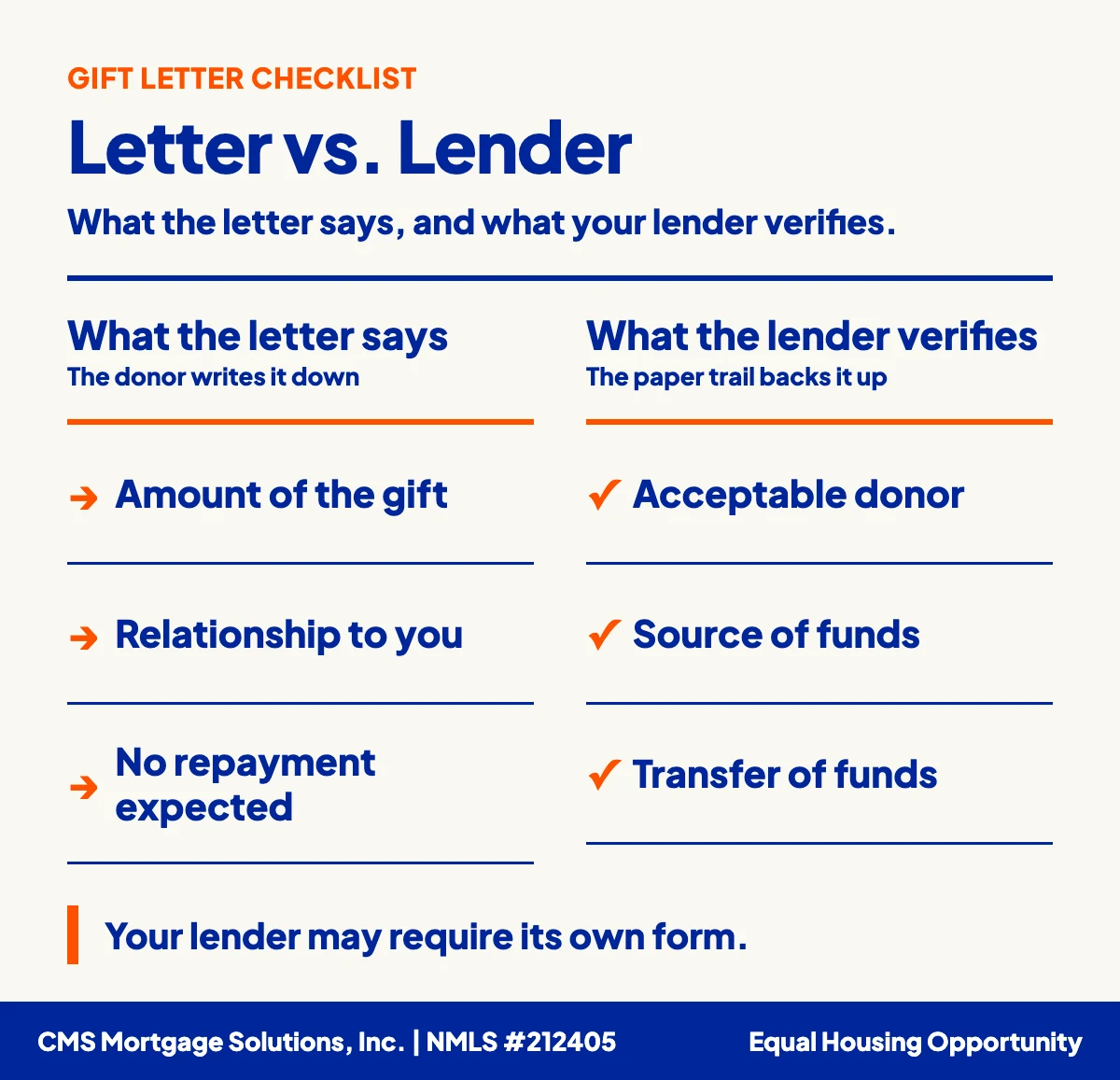
Each loan program has its own wording, but the core items are the same. Your gift letter should have:
- The donor's full name, address and phone number
- The donor's relationship to you
- The dollar amount of the gift
- A clear statement that no repayment is expected
- The donor's signature and the date
For FHA loans, HUD says the letter must be signed and dated by both the donor and the borrower.
Your lender may also ask for the property address and the bank the money is coming from. If your lender provides a gift letter form, use it.
Who can give you a gift, by loan type
The rules on who can be a donor depend on the loan program. In general, the gift cannot come from anyone with a stake in the sale, such as the builder, the developer, the real estate agent or another interested party. Programs differ at the edges, so check before the money moves.
Conventional loans (Fannie Mae and Freddie Mac)
Most conventional loans follow either Fannie Mae or Freddie Mac rules. They are close, but the wording is not identical.
Fannie Mae accepts gifts from:
- A relative. That means your spouse, child or other dependent, or anyone related to you by blood, marriage, adoption or legal guardianship.
- A non-relative with a family-like tie. That means a domestic partner or their relative, a fiance or fiancee, a former relative, or someone with a long-standing familial-like or mentorship relationship with you.
Freddie Mac accepts gifts from a "Related Person," or from a business, trust or estate tied to one. Freddie Mac defines a Related Person as your spouse, child or dependent, someone related to you by blood, marriage or adoption, your guardian or someone you are the guardian for, your fiance or fiancee, your domestic partner, or an unrelated person with close, family-like ties to you.
For both, gifts can be used on a primary home or a second home. They are not allowed on an investment property.
How much of your own money is needed? It depends on the occupancy, the type of property and the loan-to-value ratio. On a one-unit primary home, Fannie Mae and Freddie Mac generally allow eligible gift funds to cover the required funds without a minimum contribution from you. Special program rules may apply. On other property types and occupancies, a minimum from your own funds can apply, especially when the loan-to-value ratio is higher. Your loan officer confirms what applies to your loan.
If the donor lives with you. Both investors have special handling when the person giving the money lives in the home with you.
- Fannie Mae: if a donor who has lived with you for the past year gives you a gift, and you both will use the home as your principal residence, the gift counts as your own funds. When the gift is pooled with your money toward a required minimum, your lender must also collect a statement from the donor about living with you and documents that show shared residency, such as a driver's license, a bill or a bank statement with the same address.
- Freddie Mac: funds pooled with Related Persons who have lived with you for at least a year, and who will keep living with you in the new home, are treated as pooled funds instead of a gift. You sign a written statement about the source of the funds, that the money was not borrowed, and the living arrangement. Related Persons who do not live with you fall under the regular gift rules.
If your donor will live in the home or be on the loan or title, tell your loan officer before you fill out the template below. The right paperwork may be different.
Explore conventional loans.
FHA loans
HUD Handbook 4000.1 allows gifts from:
- A family member
- Your employer or labor union
- A close friend with a clearly defined and documented interest in you
- A charitable organization
- A government agency or public entity with a program that provides homeownership assistance to low- or moderate-income families or first-time buyers
HUD also says cash on hand is not an acceptable source of donor gift funds. Extra gift money cannot be counted as cash reserves.
Learn more in our FHA loans in 2026 guide.
VA loans
The VA Lenders Handbook says a gift can come from a donor who has no affiliation with the builder, developer, real estate agent or another interested party to the transaction. The gift letter must state the dollar amount, include the donor's statement that no repayment is expected, and give the donor's name, address, telephone number and relationship to you.
See our guide to VA loan eligibility requirements or explore VA loans.
USDA loans
USDA's handbook (HB-1-3555, Chapter 9) does not allow gift funds from any source with an interest in the sale, such as the seller, builder or real estate agent. USDA's loan origination FAQ says gift funds may come from any uninterested third party. Cash on hand is not an acceptable source.
The gift letter must name the donor, state the dollar amount and say the funds do not have to be repaid. Gift funds are not eligible for reserves. USDA treats gift funds as your own funds, so any excess gift money can be returned to you at closing.
Explore USDA home loans.
Mortgage gift letter template
Copy this, fill in the brackets and ask your loan officer if they need their own form instead.
> Gift Letter
>
> Date: [Date]
>
> Borrower name(s): [Borrower full name(s)]
> Property address: [Address of the home being purchased]
>
> I, [Donor full name], of [Donor street address, city, state, ZIP], phone [Donor phone number], am giving a gift of $[Amount] to [Borrower full name], who is my [relationship, for example: daughter, son, brother, mother].
>
> The gift will be sent from my account at [Bank name] by [wire / check / electronic transfer] to [the borrower's account / the closing agent] on or about [date].
>
> This is a gift. No repayment is expected or implied, in cash, services or any other form. I am not the seller, builder, developer, real estate agent or any other party with an interest in this sale.
>
> Donor signature: ______________________ Date: __________
> Donor printed name: [Donor full name]
>
> Borrower signature: ______________________ Date: __________
> Borrower printed name: [Borrower full name]
A few notes on the template:
- Do not write a full account number on the letter. Some lender forms have an optional line for the last four digits of the account. Fill that in only if your lender's form asks for it.
- Fannie Mae and Freddie Mac allow the letter to state the actual amount or a maximum amount. Other programs, such as FHA and VA, ask for the dollar amount of the gift. Ask your loan officer which to use.
- Keep the borrower signature line. FHA requires it; your lender can confirm the signature requirements for your program.
- If the amount changes, ask your lender whether an updated letter is needed, especially when the original letter states a maximum gift amount.
- If the donor lives with you, will be on the loan or title, or has any tie to the sale, do not use this template as is. Ask your loan officer first.
What lenders check besides the letter
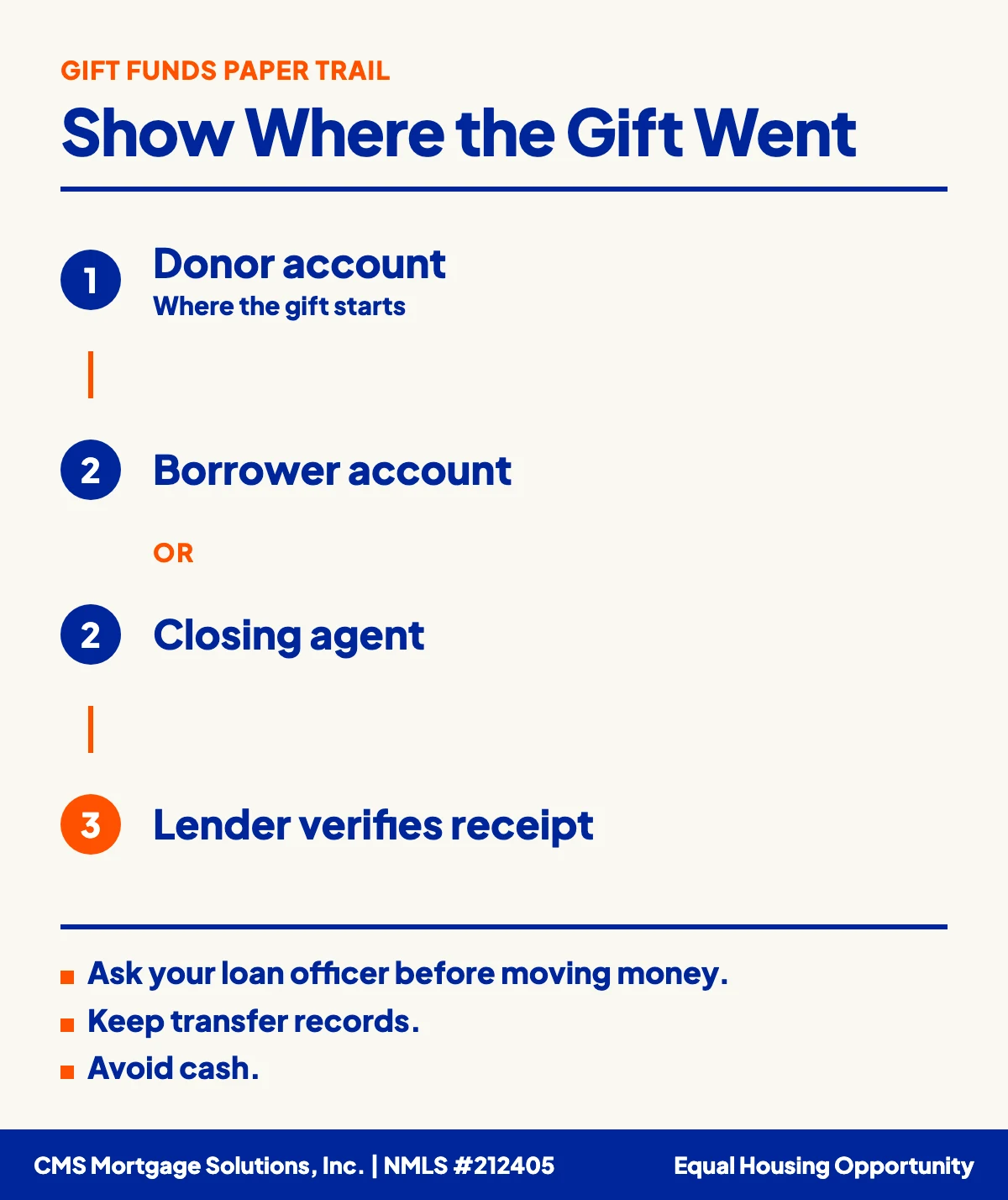
The letter says the money is a gift. The bank records prove it. Expect your lender to verify how the money moved.
For conventional loans, the lender must confirm that the gift money is in the donor's account or has already moved to yours. Fannie Mae accepts any one of these:
- A copy of the donor's check and your deposit slip
- A copy of the donor's withdrawal slip and your deposit slip
- Proof of an electronic transfer from the donor's account to yours or to the closing agent
- A copy of the donor's check to the closing agent
- A settlement statement showing receipt of the donor's check
If the money is sent at closing, it must go to the closing agent by electronic transfer, certified check, cashier's check or another official check.
Freddie Mac requires the gift to be transferred directly from the donor's account at a financial institution to your account or to the settlement or closing agent. Proof can include bank statements from both the donor and you, a canceled gift check, or a donor withdrawal slip with your deposit slip, or a cashier's check or wire confirmation for money sent to the closing agent. If a money transfer app is used, the file must show the funds moved directly from the donor's bank account to your bank account or the closing agent.
For FHA loans, HUD lists the proof by timing. For a gift that is verified before closing, the lender must get one of these:
- The donor's bank statement showing the withdrawal, plus evidence of the deposit into your account
- A copy of the donor's canceled check, plus evidence of the deposit into your account
- A copy of the donor's withdrawal receipt, plus evidence of the deposit into your account
- Evidence of the electronic transfer from the donor's account to your account
For a gift verified at closing, the lender must get one of these showing payment to the settlement agent: evidence of an electronic transfer from the donor's account, a bank certified check, a cashier's check or another official bank check.
So a donor bank statement is one acceptable document for an FHA gift that arrives before closing, but it is not the only one. Whatever the file uses, the lender must also be able to reasonably determine that the money did not come from an unacceptable source.
For VA loans, the lender must verify that the gift has been transferred to your account or will be documented as received by the closing agent at closing. Acceptable proof includes evidence of your deposit, a copy of the donor's funds by check or electronic transfer to the closing agent, or the Closing Disclosure showing receipt of the donor's funds.
For USDA loans, the lender must verify that the gift has been transferred to your account or will be documented as received by the closing agent at closing. Acceptable proof includes evidence of your deposit, a copy of the donor's check or electronic transfer to the closing agent, or the Closing Disclosure showing receipt of the donor's funds.
Your lender may ask for more than the program minimum. That can be the lender's own policy, called an overlay. Ask your loan officer what your file needs.
Common mistakes to avoid
- Moving cash. If the donor withdraws cash and hands it to you, the paper trail breaks. FHA and USDA say cash on hand is not an acceptable source of donor gift funds, and every program needs a documented transfer. Use a wire, check or electronic transfer.
- Splitting the gift into many transfers. Each deposit has to tie back to the letter. One transfer for the full amount is easier to document.
- Amounts that do not match. If the letter says one number and the deposit shows another, expect a follow-up request.
- Vague repayment wording. Phrases like "pay me back when you can" turn a gift into a loan. The letter must say plainly that no repayment is expected.
- The wrong donor. An interested party generally cannot give you a personal gift for the purchase. Exceptions and separate gift-of-equity rules may apply. Check the donor with your lender before the money moves.
Gift money and other help
Many buyers pair family help with state or local assistance. See our guide to down payment assistance programs in 2026 and down payment options explained.
Remember that closing costs are separate from your down payment. Our closing costs guide covers what to expect. Buying for the first time? Start with our first-time homebuyer guide.
FAQ
What is a gift letter for a mortgage?
It is a signed statement from the person giving you money for your home purchase. It confirms the amount, the donor's relationship to you and that no repayment is expected.
Can my whole down payment be a gift?
It depends on the loan, the occupancy and the property. On a one-unit primary home, Fannie Mae and Freddie Mac generally allow eligible gift funds to cover the required funds without a minimum contribution from you. Special program rules may apply. On other property types and occupancies, a minimum from your own funds can apply, especially when the loan-to-value ratio is higher. On FHA loans, a gift from an acceptable donor can be used toward the required minimum investment. Your loan officer can confirm what applies to you.
Can a friend give me gift money?
On an FHA loan, a close friend with a clearly defined and documented interest in you may give a gift. On a conventional loan, a non-relative must fit a family-like category. Fannie Mae lists a fiance or fiancee, a domestic partner or someone with a long-standing familial-like or mentorship relationship. Freddie Mac allows an unrelated person with close, family-like ties to you. VA and USDA allow donors who have no interest in the sale.
Can I use gift money to buy an investment property?
Not with a conventional loan. Fannie Mae and Freddie Mac do not allow gift funds on investment properties.
Can the donor send the money straight to closing?
Yes. Fannie Mae, Freddie Mac, FHA, VA and USDA all allow the gift to go to the closing agent. Your lender still needs proof of the transfer.
Can extra gift money be returned to me at closing?
It depends on the program. USDA says gift funds are considered your own funds, so excess gift funds are eligible to be returned to you at closing. FHA does not let you count surplus gift funds as cash reserves. Ask your loan officer how your loan handles any extra.
Does the donor have to pay tax on the gift?
Gift tax rules apply to the donor, not to you. The IRS says the person making a gift generally files a gift tax return (Form 709) when the gifts they give go over the annual exclusion for the year, and that return is required even if no gift tax is payable. Filing a return is not the same as owing tax. The donor should talk to a tax professional about their own situation. See the IRS gifts and inheritances FAQ and the Instructions for Form 709.
Talk to a CMS loan officer
Getting the gift paperwork in order before the money moves can help avoid follow-up requests. A CMS loan officer can tell you which rules apply to your loan, check your donor before any money moves and help you build a clean paper trail. Talk to a loan officer or find a loan officer in your state.
Sources
- Fannie Mae Selling Guide B3-4.3-04, Personal Gifts
- Freddie Mac Single-Family Seller/Servicer Guide, Section 5501.4, Other sources of funds
- Freddie Mac Guide, Section 5501.3, Assets (pooled funds, minimum contribution)
- Freddie Mac Guide Glossary, Related Person
- HUD Handbook 4000.1, FHA Single Family Housing Policy Handbook (Gifts, Personal and Equity)
- HUD Handbook 4000.1 information page
- VA Lenders Handbook, VA Pamphlet 26-7, Chapter 4, Credit Underwriting
- USDA HB-1-3555, Chapter 9, Income Analysis (Gift Funds)
- USDA Single Family Housing Guaranteed Loan Program FAQ, Origination (Gifts)
- IRS, Gifts and Inheritances FAQ
- IRS, Instructions for Form 709
---
This content is for educational purposes and does not constitute financial advice. Loan terms and availability vary by borrower. Pre-approval is subject to credit, income, asset, and property verification. It is not a commitment to lend.
CMS Mortgage Solutions, Inc. | NMLS #212405 | Virginia Beach, VA. Equal Housing Opportunity. NMLS Consumer Access. This is not a commitment to lend. Programs, rates, terms and conditions are subject to change without notice.