

If you lost your job and can't pay your mortgage, start with the company listed on your mortgage statement. You do not need to wait for a missed payment. The Consumer Financial Protection Bureau (CFPB) recommends calling your servicer right away, even if you are only worried about missing a payment.
Lost your job and can't pay the mortgage? Do this first
Call your mortgage servicer now and explain the job loss. Ask for its mortgage assistance application and which hardship options it can consider. Contact a HUD-participating housing counselor for independent help. Do not stop paying on your own or assume forbearance erases what you owe. Assistance is not automatic.
If you are asking about buying a home while receiving unemployment benefits, the purchase-income section below addresses that separate question. An application for a new mortgage is not a request for help with your existing loan.
Contact your mortgage servicer first
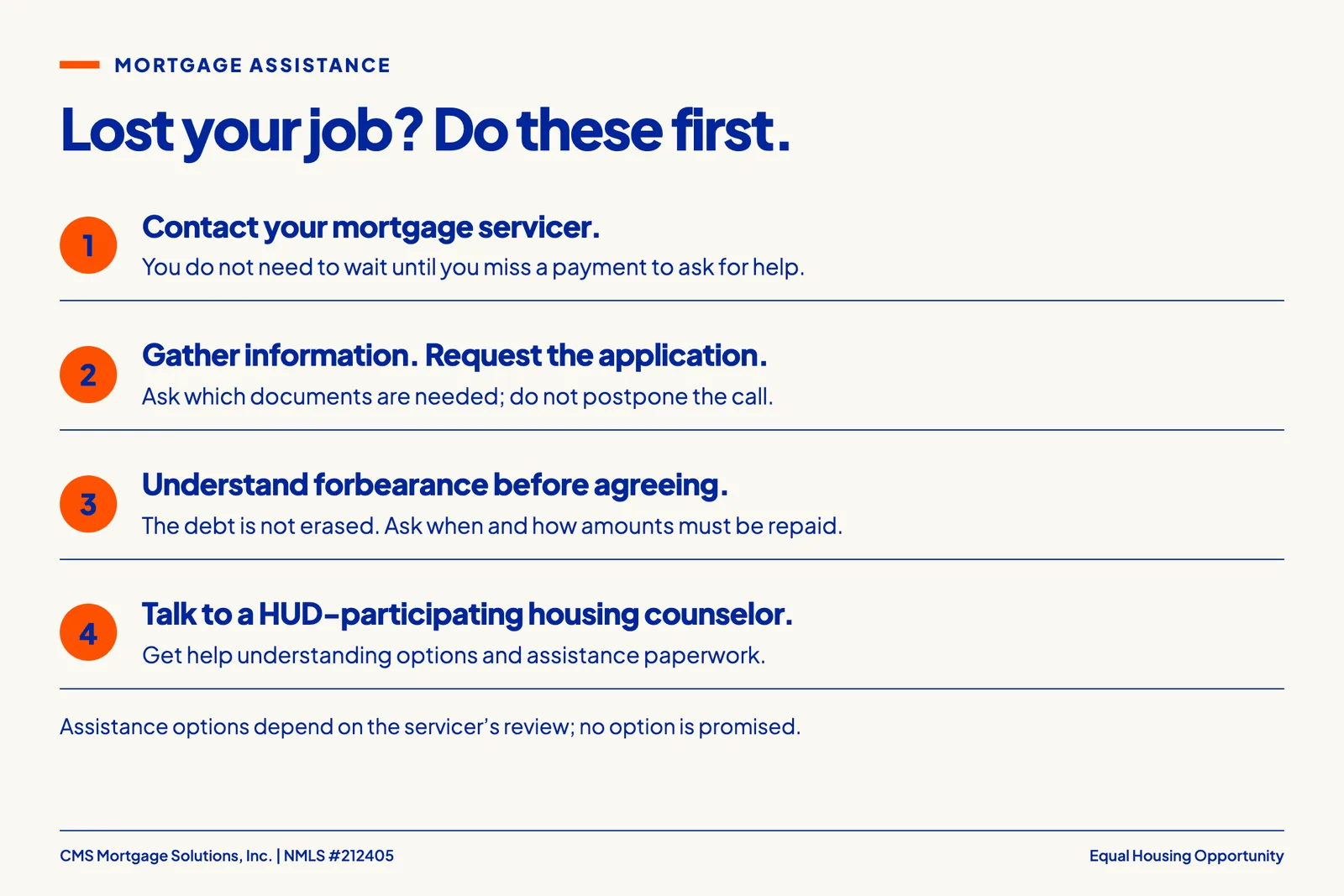
Look on your monthly mortgage statement for the servicer's telephone number. CFPB also points to the mortgage coupon book or the servicer's website. If you cannot identify your servicer, ask a HUD-participating housing counseling agency for help.
Tell the servicer that you lost your job and are concerned about making the mortgage payment. Explain whether you expect the hardship to be temporary or ongoing. If you do not know when you will return to work, say so rather than guessing.
You can use a direct opening when you call.
"I lost my job and am worried about paying my mortgage. I want to ask about mortgage assistance. What should I submit, and what happens next?"
That is a suggested script, not a quote from a borrower or a promise about the response. Ask the representative to explain anything you do not understand. Write down the contact information and the next action you are asked to take.
Gather information and request the assistance application
CFPB recommends being ready to explain why you cannot pay, whether the problem is temporary or permanent, and the details of your income, expenses and other assets, including cash in the bank.
Before calling, gather the information you have available. Use these questions to organize it.
- What changed when the job ended?
- What income is coming in now?
- What are your current expenses?
- What money or other assets do you have available?
- What do you know, and what remains uncertain, about returning to work?
Do not postpone the call while trying to prepare a perfect explanation. Tell the servicer what you know and ask which supporting documents it needs.
If the servicer supplies a mortgage assistance application, complete it. The servicer assesses the application and tells you which loss-mitigation options, if any, it can offer. CFPB lists repayment plans, loan modifications and forbearance among possible options. This is a list of possibilities to discuss, not a recommendation to choose a particular arrangement.
Ask how to submit the requested information, how to check whether the application is complete and whom to contact about the review. Keep your submitted materials and notes together so you can refer to them during the next conversation.
What is mortgage forbearance after job loss?
Mortgage forbearance is an arrangement with your servicer or lender to pause mortgage payments temporarily or make smaller payments. It can address a hardship such as job loss, but it does not erase the debt. You must repay the missed or reduced amounts under the arrangement's terms.
Do not treat the word "pause" as permission to stop paying on your own. Ask the servicer to explain the arrangement it is offering before changing how you pay.
Repayment arrangements vary. CFPB describes different ways paused or reduced payments may be repaid, so do not assume another homeowner's arrangement will apply to your loan.
Use these questions during the discussion.
- Will payments pause or become smaller, and for how long?
- What must I pay during the arrangement?
- How will interest accrue during that time?
- When and how must I repay the paused or reduced amounts?
- What happens when the arrangement ends?
- What should I do if my income has not recovered by then?
Ask for the explanation in writing and read it before agreeing. If the repayment explanation is unclear, ask the representative to walk through it again or review it with a housing counselor.
Compare mortgage hardship options
CFPB lists several possible loss-mitigation options. Loss mitigation means options your servicer considers to address trouble paying the mortgage. The differences below matter when you ask for help. They are not a menu of options every borrower can choose.
| Option | What it does | What to check before deciding |
|---|---|---|
| Forbearance | Temporarily pauses payments or allows smaller payments by arrangement. | When and how you must repay the missed or reduced amounts. The debt remains. |
| Repayment plan | Adds part of the past-due amount to regular payments over time. | Whether you can afford the larger payments while catching up. |
| Loan modification | Changes the terms of the existing mortgage. | How the proposed terms affect what you owe now and over the life of the loan. |
| Short sale | Sells the home for less than the mortgage debt, if the lender or servicer agrees. | You must leave the home. Ask a housing counselor and attorney about any debt remaining after the sale. |
| Shared review for every option | Do not assume availability from this table. | Ask your servicer which options it can offer and review the obligations with a housing counselor before deciding. |
CFPB also lists refinancing and a deed-in-lieu of foreclosure among possible options. This article does not assess those alternatives or promise access to them. Ask your servicer and counselor whether they belong in your discussion. If keeping the home is no longer workable, ask about selling rather than assuming that a sale automatically clears the debt.
Find independent housing counseling
A housing counselor can help you understand the options your servicer offers and work through the process and paperwork. HUD's housing counseling guidance says foreclosure counseling through participating agencies is always free.
Use the housing counseling search tool linked by HUD to find an agency. Ask specifically about help with mortgage delinquency or foreclosure concerns. HUD notes that participating agencies do not all offer every type of counseling.
Bring your mortgage statement, your notes from the servicer conversation and any assistance paperwork to the discussion. Ask the counselor to help you understand the proposed arrangement and prepare questions you still need answered.
If you face imminent foreclosure or have received legal papers, CFPB says you may also need to consult an attorney. Seek legal advice about those papers rather than relying on a general article to interpret them.
Does mortgage insurance cover job loss?
No. Conventional private mortgage insurance (PMI) protects the lender if you stop making payments. It does not replace lost wages or pay your mortgage because you became unemployed. If you bought a separate protection policy, ask its insurer about that policy. Do not assume a PMI charge includes job-loss coverage.
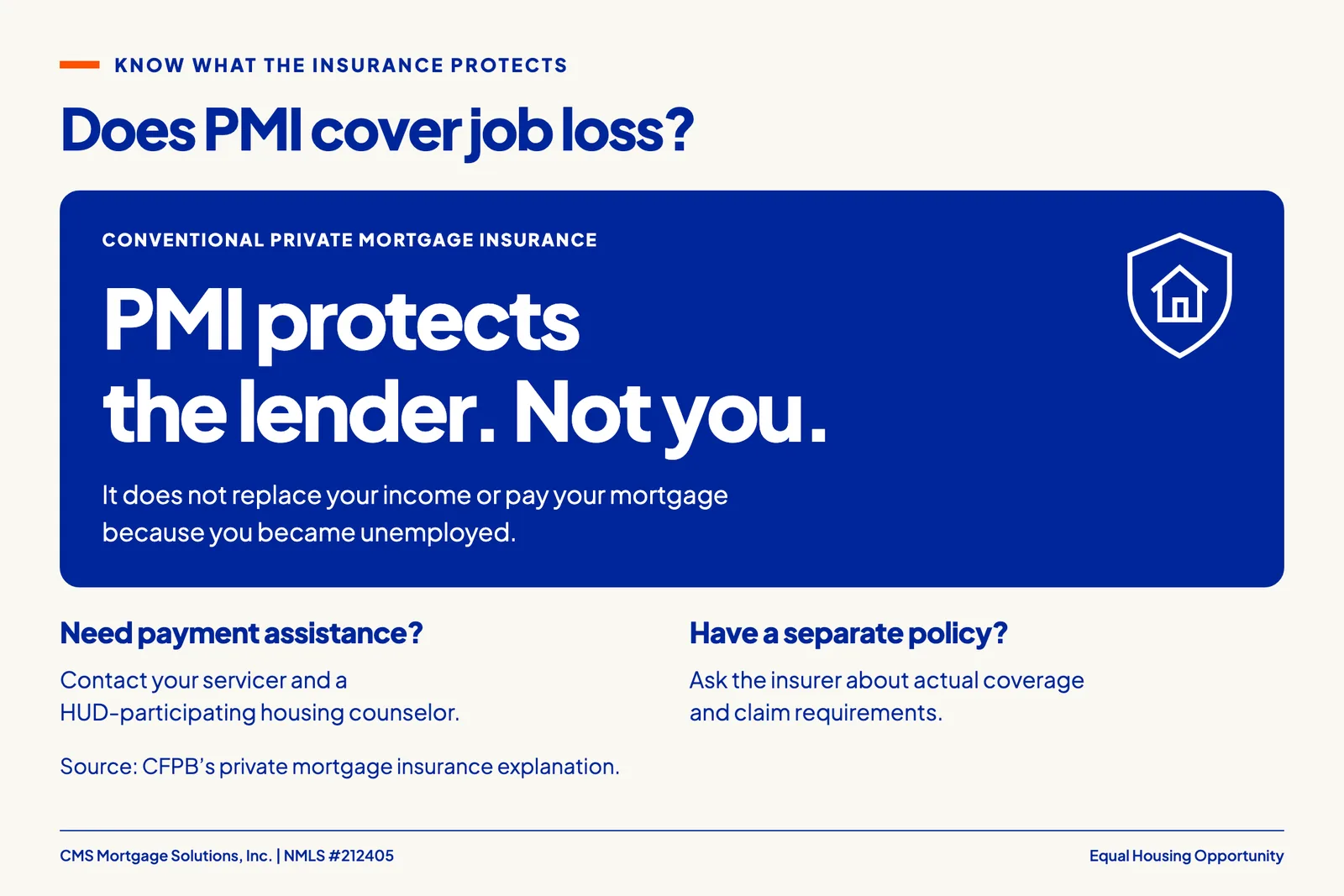
CFPB's PMI explanation makes the distinction explicit. PMI does not protect you against losing your home through foreclosure.
Keep PMI separate from any protection policy you may have independently purchased. If you have a separate policy, ask the insurer to explain its actual coverage and claim requirements. This article does not assess any insurer's product or promise a payout. For general terminology, see our guide to how mortgage insurance works.
Can you buy a house while on unemployment?
Unemployment benefits do not provide a blanket answer about buying a house. Fannie Mae permits consideration of benefits associated with seasonal employment when its income-history and documentation requirements are met. That limited provision does not mean all unemployment benefits count. A lender must review the selected program and your complete file.
Fannie Mae's unemployment benefits income guidance, dated March 4, 2026, addresses benefits associated with seasonal employment. It permits consideration of that income when benefits have been consistently received for at least two years. The lender must obtain two years of signed personal federal income tax returns.
The guide also addresses income history, continuance and the historical trend used to calculate qualifying income. Stable or increasing income uses an average from the most recent two years of personal federal returns. Decreasing income uses an average from the most recent year. The lender does not have to verify continuance unless it has reason to believe the income may not continue.
This seasonal-income provision does not mean all unemployment benefits count toward a purchase mortgage. The same guide separately discusses financial resources under an employment-offer provision and a high-LTV refinance scenario. Those are not general purchase-income exceptions and are outside this article's scope.
Ask a loan officer which program is being considered and what documentation that program requires. Our debt-to-income guide provides separate background for the buyer discussion. Eligibility, terms and required documents depend on the selected program and complete file.
If your question concerns a future purchase, you can start a purchase conversation with CMS. That optional application path is for buyers, not servicing relief. For a general CMS question, contact CMS. For help with payments on an existing mortgage, return to your servicer and a housing counselor.
Avoid mistakes that make the next step harder
- Do not wait for your savings to run out before calling. Explain the income and assets you have now.
- Do not agree to a repayment arrangement you do not understand. Ask a counselor to review the explanation with you.
- Be wary of demands for upfront fees, promises to prevent foreclosure, or instructions to send mortgage payments to someone other than your servicer. CFPB identifies these as foreclosure scam warning signs.
- Do not use a new purchase application as a request for hardship help. Contact the servicer for your current loan.
Key takeaways
- Call your servicer as soon as you are worried about paying. Use the number on your mortgage statement.
- Ask for the assistance application and explain your income, expenses and available assets honestly.
- Compare the repayment obligations, not just the temporary relief. Forbearance does not cancel debt.
- Use HUD-participating housing counseling. Foreclosure counseling is free. Seek an attorney's advice about legal papers.
- Treat buying on unemployment as a separate income-review question.
Frequently asked questions
Can I pause my mortgage after losing my job?
Ask your servicer whether forbearance or another hardship option is available. Forbearance requires an arrangement with the servicer or lender. Losing a job does not automatically pause your payments.
Does PMI cover job loss?
No. PMI protects the lender against loss when a borrower stops making payments. It does not replace your income or pay your mortgage because you lost your job.
Does forbearance erase the payments?
No. You still owe the full amount. Ask your servicer when and how you must repay any missed or reduced payments and what happens when the arrangement ends.
Can unemployment benefits count when buying?
Fannie Mae permits consideration of unemployment benefits associated with seasonal employment when its history and documentation requirements are met. That is not a general rule for all benefits or mortgage programs. Ask for a review of your complete file.
Where can I find housing counseling?
Use HUD's housing counseling search tool to find a participating agency and ask about mortgage or foreclosure counseling. Foreclosure counseling is free. If you have received legal papers or face imminent foreclosure, you may also need an attorney.
CMS Mortgage Solutions, Inc. | NMLS #212405 | Equal Housing Opportunity. Program availability and borrower eligibility depend on the full application and current guidelines.