

The benefits of using a mortgage broker deserve the same scrutiny as the drawbacks. This guide comes from a broker's perspective. Use the questions here when speaking with us, too.
A mortgage broker helps you find lenders or mortgage loans without lending the money. The potential benefit is help with the search. The tradeoffs are compensation, the scope of that search and relying on another contact. Ask what the service includes, then compare actual offers from brokers and direct lenders.
The Consumer Financial Protection Bureau (CFPB) explains that a broker helps you find lenders or mortgage loans rather than lending the money. The choice should depend on the proposed service and loan offer, not the job title alone.
Mortgage broker pros and cons at a glance
| Potential benefit | Limitation or question to resolve |
|---|---|
| Help finding lenders and mortgage options | Which lenders will the broker consider, and what falls outside that search? |
| A broker typically works with multiple lenders | What alternatives were considered for your particular situation? |
| A service you can ask to have explained before engaging | What work will the broker handle, and what remains with you? |
| Help discussing the choices presented | Who will explain the lender's decision and answer follow-up questions? |
What does a mortgage broker do?
A mortgage broker helps you find lenders or mortgage loans but does not lend the money. A lender makes direct loans. Before choosing a broker, ask which lenders they will consider and which tasks they will handle. Separate those services from the information and documents you still need to provide.
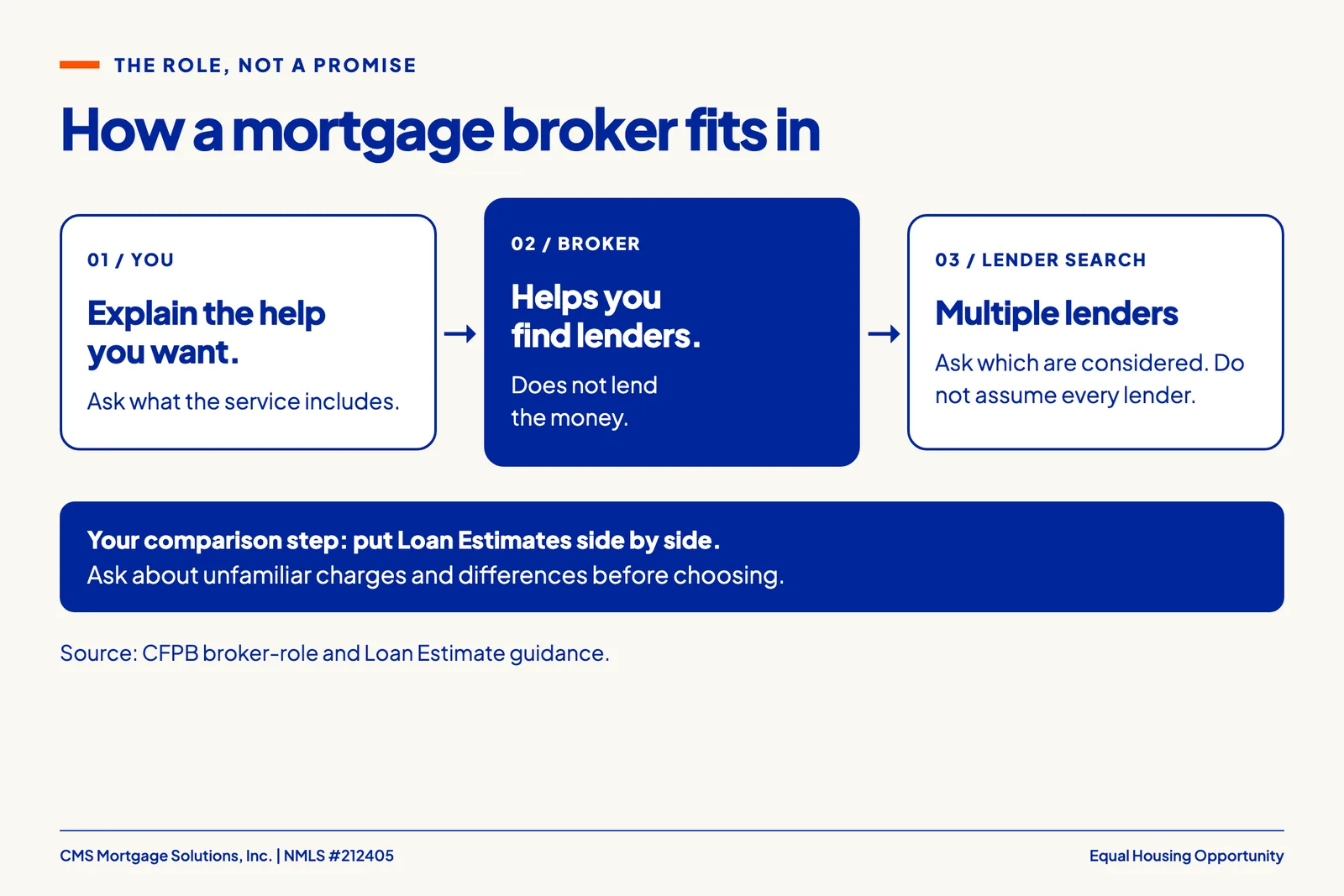
A lender makes direct loans. A broker does not lend the money, according to the CFPB's explanation linked above. Keep that distinction in mind when asking who is responsible for each part of your application.
Before agreeing to work together, ask the broker to describe the service in practical terms. Will they explain why particular lenders are being considered? Who should you contact with questions about requested documents? Who will communicate the lender's decision?
Ask for a clear description of your own responsibilities, too. Rather than assuming the broker will handle every task, ask what information you need to provide and how to submit it. Eligibility, terms and required documents depend on the selected program and the complete file.
For a separate look at the available channels, read our broker, bank and online lender comparison. Here, focus on whether the specific broker's proposed service fits the help you want.
Benefits of using a mortgage broker
Help finding options
Brokers typically work with multiple lenders, as the CFPB notes. Ask how that search would work for you. Request an explanation of which lenders the broker plans to consider and why.
Do not assume that multiple lenders means every lender. Ask what is outside the search and whether you should seek additional offers yourself. Judge the scope of the search by the broker's explanation, rather than by the word "independent" alone.
Help understanding the choices
Ask the broker to walk you through the offers presented and explain the reasons for a recommendation. Bring your questions about the disclosures to that conversation. If an answer is unclear, ask them to point to the relevant part of the document.
Be specific about the help you want. For example, ask for an explanation of an unfamiliar charge rather than accepting a general assurance about the whole offer. Request written answers to questions you want to revisit before choosing.
Communication that fits your needs
Before engaging, ask who your contact will be and how to reach them. Find out who handles questions when that person is unavailable. Ask how you will hear about document requests or a lender decision.
Consider whether those answers suit you. If you want written updates, say so. If you would rather discuss a document by phone before responding, ask whether that is part of the service. Do not assume a particular communication arrangement without checking.
Disadvantages of using a mortgage broker
A broker relationship can leave important work with you. Treat these as reasons to investigate the proposed arrangement before committing.
- The lender search needs boundaries. Ask which lenders will be considered and what you would need to explore separately. Do not mistake a broker's recommendations for a review of the entire market.
- Compensation needs explanation. Find out who pays and what you would owe under the proposed arrangement. Review the documents even when compensation is lender-paid.
- Another contact can mean uncertainty about responsibilities. Ask who handles document requests, who explains lender decisions and whom to contact if a question goes unanswered. If you prefer dealing directly with a lender, weigh that preference seriously.
- Hiring help does not replace your comparison. Request actual Loan Estimates and review unfamiliar charges yourself. Ask for clarification before choosing, even if you like the person making the recommendation.
Mortgage broker vs. bank or direct lender
| Decision point | Mortgage broker | Bank or direct lender |
|---|---|---|
| Role | Helps find lenders or mortgage loans; does not lend the money | Makes direct loans |
| Search | Typically works with multiple lenders; ask which will be considered | Ask which of its loan options it would consider for you |
| Contact preference | Ask how the broker and lender divide responsibilities | Ask who at the lender will handle your application questions |
| Compensation questions | Ask who pays the broker and where to review compensation | Ask the lender to explain charges and its loan officer's compensation |
| Tradeoff to weigh | Consider this route if you want help finding lenders; check the service and search scope | Consider this route if you prefer approaching a lender yourself; decide how you will compare outside offers |
| Parity point | Compare actual Loan Estimates and check authorization | Compare actual Loan Estimates and check authorization |
Who pays a mortgage broker?
The borrower or lender pays the broker's loan-specific compensation, usually a fee or commission, according to the CFPB. Ask who pays under the proposed arrangement, what the compensation covers and where to review it in the documents. Do not treat the phrase "lender-paid" as a reason to ignore costs.
For covered closed-end consumer loans secured by a dwelling, Regulation Z restricts dual compensation. When an originator receives compensation directly from the consumer, the rule generally bars compensation from another person to a loan originator for that transaction. A consumer-paid brokerage may still compensate its individual originators, subject to the rule's restrictions.
Do not read "lender-paid" as a reason to skip reviewing the loan's costs. Ask how the proposed arrangement works, and compare the complete disclosures. This guide does not state a CMS fee arrangement; request the details for your transaction.
What about compensation conflicts?
For those covered transactions, Regulation Z prohibits originator compensation based on transaction terms or their proxies. Its anti-steering rule prohibits directing a consumer into a transaction because it pays the originator more creditor compensation, unless the transaction is in the consumer's interest.
Use that rule as context when asking about a recommendation. Do not treat it as a substitute for your own questions. Ask why the broker recommends the loan, what alternatives were considered and how the compensation works. This is borrower education, not legal advice about a particular transaction.
Compare offers and check authorization
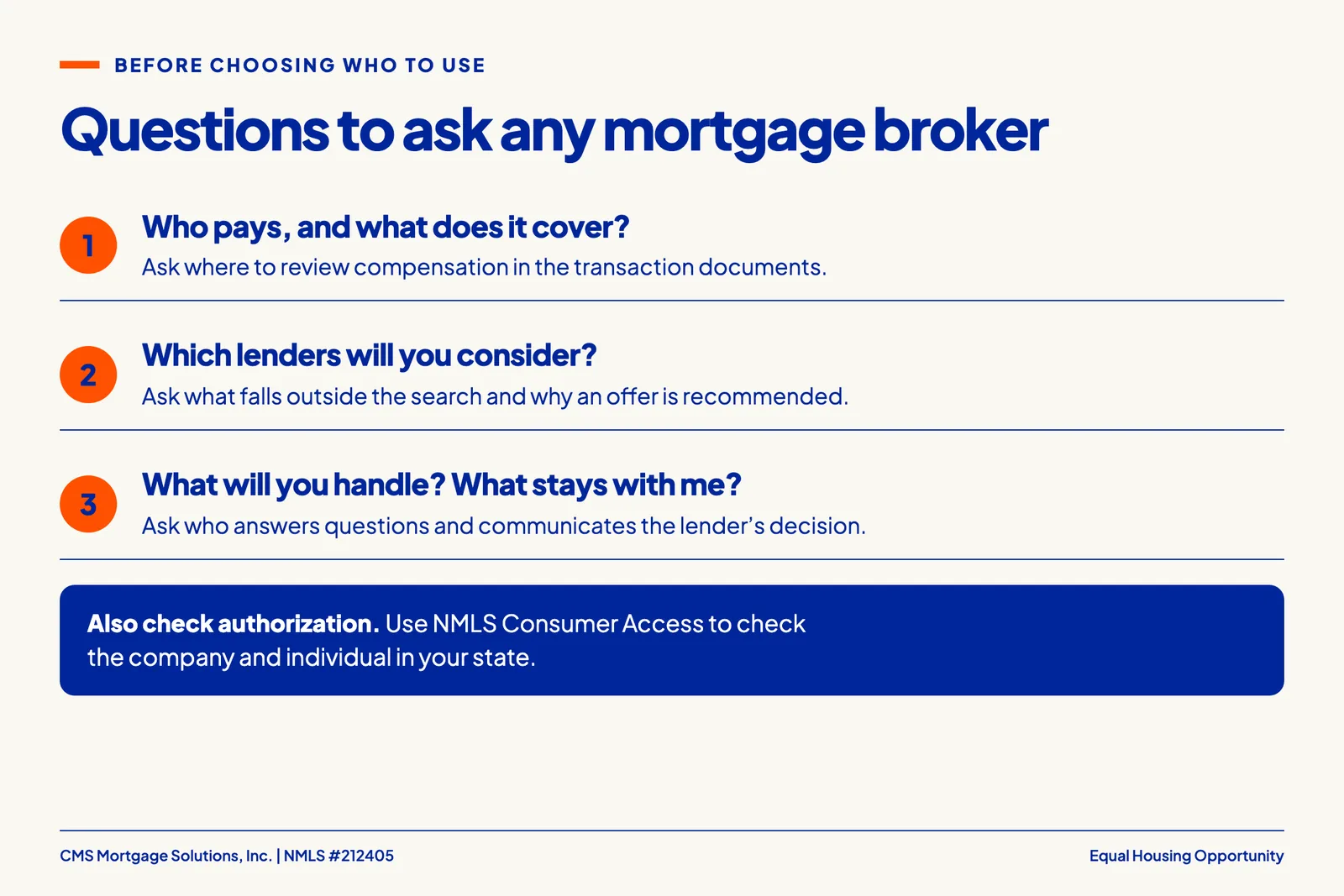
The CFPB recommends requesting Loan Estimates from multiple lenders. A Loan Estimate is a standardized form with important details about a loan offer. It also separates costs so you can see what each charge represents.
Use this checklist with the actual documents in front of you.
- Request Loan Estimates from multiple lenders, including an offer outside the broker's recommendations if you want an additional comparison.
- Put the estimates side by side. Ask whether the underlying loan details are comparable before drawing a conclusion.
- Ask the broker or lender to identify and explain unfamiliar charges and differences between the offers.
- Write down who pays broker compensation under each proposed arrangement and where to review it.
- Keep the estimates and written answers together so you can refer to both when choosing.
Also check the company and individual through NMLS Consumer Access. The CFPB's license-check guidance describes this as a free service for checking whether a financial-services company or professional is authorized to do business in your state. It also points to state regulators for checking disciplinary actions. Keep that check separate from evaluating the proposed service and offer.
Is a mortgage broker worth it?
Consider a broker if you want help finding lenders and discussing mortgage options. Consider contacting a lender directly if you prefer managing that search yourself. Neither choice replaces comparing actual offers. Before engaging anyone, ask about the service, lender search, compensation and how questions about your file will be handled.
If your income or property needs a detailed explanation, ask how the person would approach those details and what documents they need. Do not assume the broker label alone tells you whether that person understands your situation. Eligibility, terms and required documents depend on the selected program and the complete file.
Key takeaways
- A broker helps find lenders or mortgage loans; the broker does not lend the money.
- Ask what the lender search includes, what it excludes and who handles each task.
- Understand compensation and review costs even under a lender-paid arrangement.
- Compare actual Loan Estimates, whether you start with a broker or a direct lender.
- Check both the company and individual through NMLS Consumer Access, and ask your state regulator about disciplinary information.
Frequently asked questions
Are mortgage brokers worth it?
Consider a broker if you want help finding lenders and discussing mortgage options. Ask what the service includes, how broad the lender search will be and how compensation works. Compare the actual offers before choosing.
What are the disadvantages of using a mortgage broker?
You need to understand the limits of the lender search, how compensation works and how the broker and lender divide responsibilities. You still need to compare actual offers. Ask for those details before deciding whether the proposed service suits you.
Is it better to use a mortgage broker or a bank?
Choose based on the service you want and the actual offers you receive. A broker helps find lenders or mortgage loans, while a lender makes direct loans. Ask how each would handle your questions and compare Loan Estimates rather than choosing by the label alone.
Can I get a mortgage without a broker?
You can approach a lender directly. The CFPB distinguishes lenders, which make direct loans, from brokers, which help find lenders or mortgage loans. If you prefer contacting lenders yourself, use the same questions about costs, communication and authorization.
Who pays a mortgage broker?
The borrower or lender pays the broker's loan-specific compensation. Ask who pays under the proposed arrangement and review the disclosures. Do not skip reviewing costs because the arrangement is described as lender-paid.
Does a broker compare every lender?
Ask the broker which lenders will be considered and what falls outside the search. Request an explanation of the alternatives considered for your situation rather than assuming the search covers the whole market.
How do I check a broker's license?
Use NMLS Consumer Access to check whether the individual and company are authorized to do business in your state. The CFPB also recommends checking with your state regulator for disciplinary information.
Questions for CMS
Read how CMS works and about the company, then bring the same questions to us. If you want to begin an application, get started with CMS. Program availability and borrower eligibility depend on the full application and current guidelines.
CMS Mortgage Solutions, Inc. | NMLS #212405 | Equal Housing Opportunity. Program availability and borrower eligibility depend on the full application and current guidelines.