
The short answer
An earnest money deposit is money you put down after the seller accepts your offer. It shows you are serious. The seller or a third party, such as a title company or real estate agent, holds it. If the sale closes, the deposit may be applied to your down payment or closing costs. If the contract ends for a reason the contract allows, you get it back. If you do not perform in good faith, the seller may keep it. Your lender may also ask for proof of where the money came from and that it was received.
What earnest money is
The Consumer Financial Protection Bureau (CFPB) defines earnest money as a deposit a buyer pays to show good faith on a signed contract to buy a home. The seller or a third party holds it until closing.
Earnest money is paid early, often soon after you sign the contract. It is not an extra cost on top of your purchase. At closing, it may be applied to your closing costs or down payment, so it counts toward the cash you bring.
For a new construction home, a builder may ask for an upfront builder deposit, also called earnest money. The CFPB suggests asking the builder under what conditions that deposit can be returned before you commit.
How much earnest money to put down
No fixed national amount applies. You and the seller negotiate it, and it is written into the purchase contract. The North Carolina Real Estate Commission (NCREC) describes it as typically a small percentage of the purchase price. The amount can vary with local market conditions, the price, the type of property and other factors.
Your real estate agent can tell you what is customary where you are buying.
Keep one thing in mind. A larger deposit is more money at risk, and it can mean more paperwork for your lender. More on that below.
Who holds the deposit
Your purchase contract should spell out:
- How much you will deposit
- When you must deliver it
- Who will hold it, and whether it sits in a trust or escrow account
- Whether it is credited toward the price at closing
- What happens to it if the sale does not close
The NCREC notes that most buyers prefer a licensed agent or attorney to hold the deposit, since those professionals are required to keep it in a trust or escrow account. If a seller or builder holds the deposit, you risk not getting it back if the deal falls apart.
When you can get your earnest money back
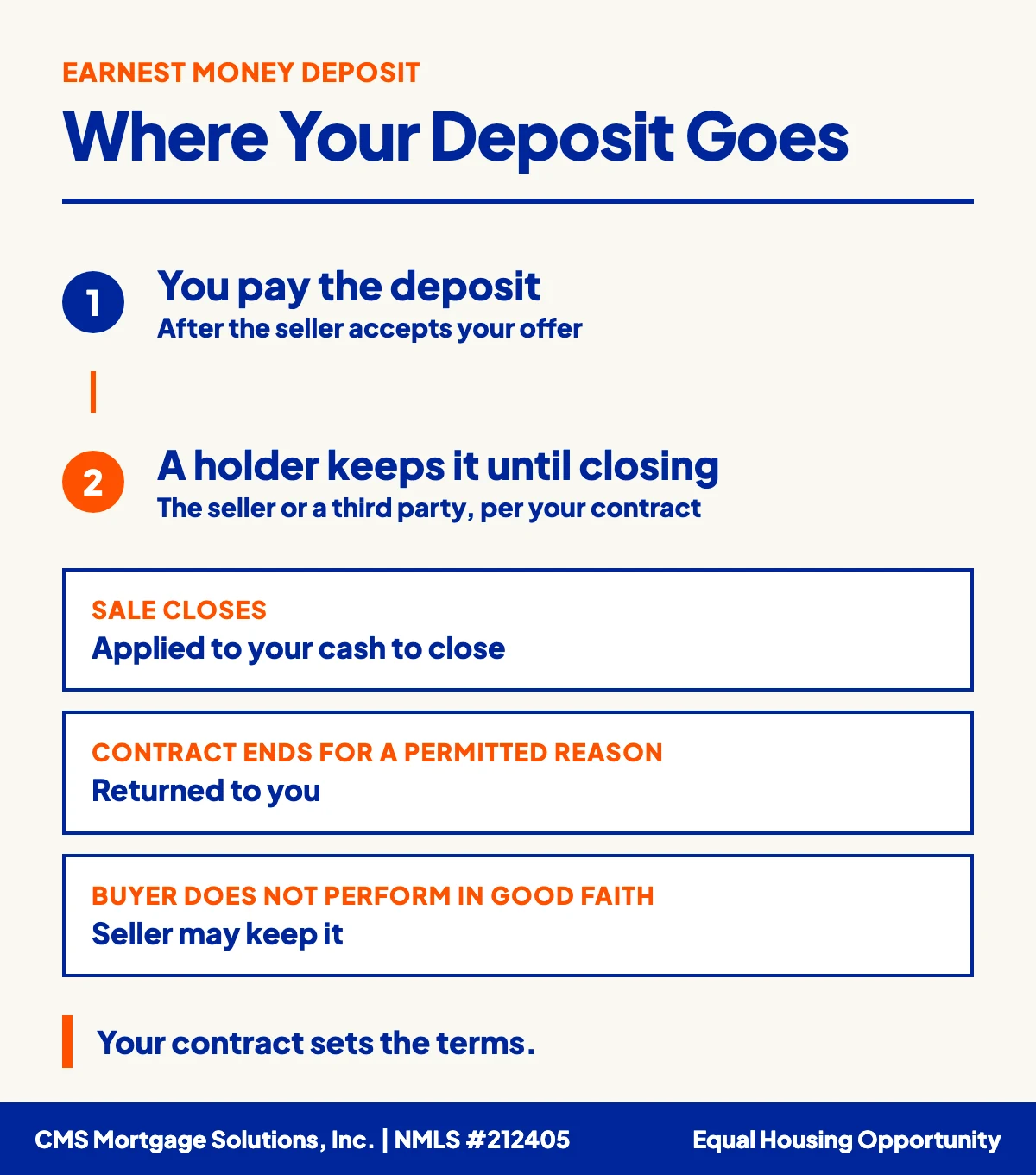
Whether you get it back depends on your contract. The CFPB says that if the contract is terminated for a permissible reason, the earnest money is returned to the buyer. If the buyer does not perform in good faith, it may be forfeited and paid to the seller.
Contracts vary, and the terms are in yours. Many purchase contracts include contingencies, which are conditions that let you cancel under set terms. Depending on your contract, these can include:
- Inspection. A window to review the home's condition and negotiate or cancel.
- Financing. A window to get your loan approved.
- Appraisal. A condition tied to the home appraising at or above the price.
- Title. A condition tied to title problems being cleared.
- Sale of your current home. A condition tied to your current home selling.
Each contingency in a contract typically has a deadline and a required way to give notice. Read yours closely. Put every deadline on your calendar the day you sign. If you are unsure what a clause means, ask your agent or a real estate attorney before you sign.
What your lender checks
Your earnest money is part of the cash you are using to buy the home. Your lender has to document it like any other asset.
For conventional loans backed by Fannie Mae, the deposit is an acceptable source of funds for the down payment and closing costs. If it is part of your required minimum contribution, the lender must verify it came from an acceptable source. Under the Selling Guide (B3-4.3-09), bank statements must show your average balance over the past two months was large enough to support the deposit. If a copy of the canceled check is used, the statements must cover the period up to and including the date the check cleared. Fannie Mae also says large deposits, and deposits above what is customary for the area, should be closely evaluated.
For FHA loans, HUD Handbook 4000.1 says the lender must verify and document the deposit amount and source if the deposit is more than 1 percent of the sales price, or is excessive based on your history of saving. This appears in the handbook's asset requirements for both TOTAL and manual underwriting, under Earnest Money Deposit. If the deposit came from a gift, the lender must also confirm the gift follows FHA's gift rules.
Proof your lender may ask for:
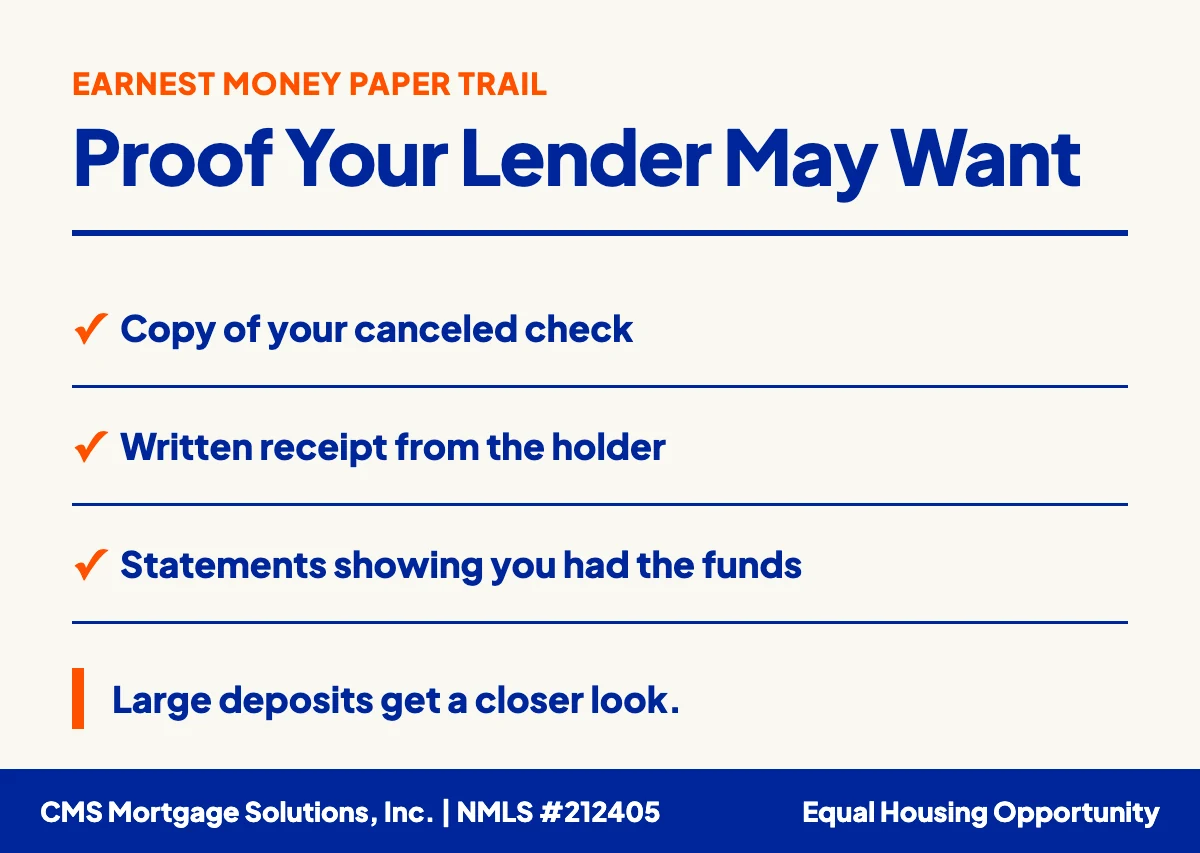
- A copy of your canceled check
- A written statement from whoever holds the deposit confirming they received it
- Bank statements or a verification of deposit showing your balance could cover the deposit
Fannie Mae verifies receipt with either your canceled check or a written statement from the holder. FHA lists those and other options. Your lender may ask for more than a program minimum. Ask your loan officer what your file will need.
How to pay earnest money safely
Real estate closings are a target for wire fraud. The CFPB warns that scammers send spoofed emails posing as your agent, settlement agent or another trusted contact, with false instructions for wiring funds. Before you send any money:
- Talk with your agent and settlement agent in person or by phone about how money will be sent.
- Never follow payment instructions that arrive only by email.
- Verify the account name and number in person or by calling a phone number you agreed on ahead of time with those contacts. Do not use a number or link in the email.
- Do not email your financial information.
Common earnest money mistakes
- Paying in cash. Cash is hard to document. A check or a transfer from your own account leaves a record your lender can follow.
- Borrowing the deposit. Fannie Mae says lenders must investigate any indications of borrowed funds. Talk to your loan officer before you borrow money for a deposit.
- Moving money around right before you pay it. The CFPB says to be ready to document the source of any large deposits in your bank records. See our guide to the mortgage pre-approval process.
- Missing a contingency deadline. Depending on your contract, the protection may end when the deadline passes.
- Not getting a receipt. Ask the holder for written confirmation once the money lands. Your lender may need it.
Earnest money and the rest of your cash to close
Earnest money is only one piece of the cash you need. Plan for the down payment and closing costs too. Our closing costs guide covers what to expect, and down payment options explained walks through ways to fund it. You may also qualify for down payment assistance programs in 2026. Buying for the first time? Start with our first-time homebuyer guide, and check the hidden costs of buying a home.
FAQ
What is an earnest money deposit?
It is a good-faith deposit you pay after your offer is accepted. The seller or a third party holds it. If the sale closes, it may be applied to your closing costs or down payment.
Is earnest money part of the down payment?
It can count toward your cash to close. The CFPB says it may be applied to closing costs or the down payment, and Fannie Mae treats it as an acceptable source of funds for both.
Can I get my earnest money back?
Yes, if the contract is terminated for a reason the contract allows. If you do not perform in good faith, the seller may keep it. Check your contract terms and deadlines.
Can earnest money come from a gift?
It can. The gift rules for your loan program apply, and your lender will need the gift paperwork. See our gift letter guide.
Does my lender need proof of my earnest money?
Often. Fannie Mae requires the lender to verify it when it is part of your minimum contribution, and FHA requires it above a set share of the sales price or when it looks excessive for your savings history. Expect to show where the money came from and that the holder received it, such as a canceled check or a written statement from the holder.
Is earnest money required by law?
It depends on where you buy and on your contract. The NCREC says no law requires it in North Carolina, although sellers typically ask for it. Ask your agent how it works in your state.
Sources
- CFPB, Mortgage key terms (Earnest money)
- CFPB, Find the right home (builder deposits)
- CFPB, Mortgage closing scams: how to protect yourself and your closing funds
- CFPB, Submit documents and answer requests from the lender
- Fannie Mae Selling Guide B3-4.3-09, Earnest Money Deposit
- Fannie Mae Selling Guide B3-4.2-02, Depository Accounts
- HUD Handbook 4000.1, FHA Single Family Housing Policy Handbook
- HUD Handbook 4000.1 information page
- North Carolina Real Estate Commission, Earnest Money Deposits
Talk to a CMS loan officer
Earnest money is simple when it is planned. A CMS loan officer can tell you what your lender will need before you write the check, so your paper trail is clean from day one. Talk to a loan officer or find a loan officer in your state.
---
This content is for educational purposes and does not constitute financial advice. Loan terms and availability vary by borrower. Pre-approval is subject to credit, income, asset, and property verification. It is not a commitment to lend.
CMS Mortgage Solutions, Inc. | NMLS #212405 | Virginia Beach, VA. Equal Housing Opportunity. NMLS Consumer Access. This is not a commitment to lend. Programs, rates, terms and conditions are subject to change without notice.