
The short answer
A proof of funds letter is a document that shows you have liquid money ready for a home purchase. Sellers and their agents often ask for it with an offer. For a cash buyer, it usually needs to cover the price plus closing costs. For a financed buyer, it usually needs to cover your down payment, closing costs and any reserves. Your mortgage lender will still verify the money under its own rules, such as with bank statements or a direct verification. A seller-facing letter alone is not underwriting.
What a proof of funds letter is
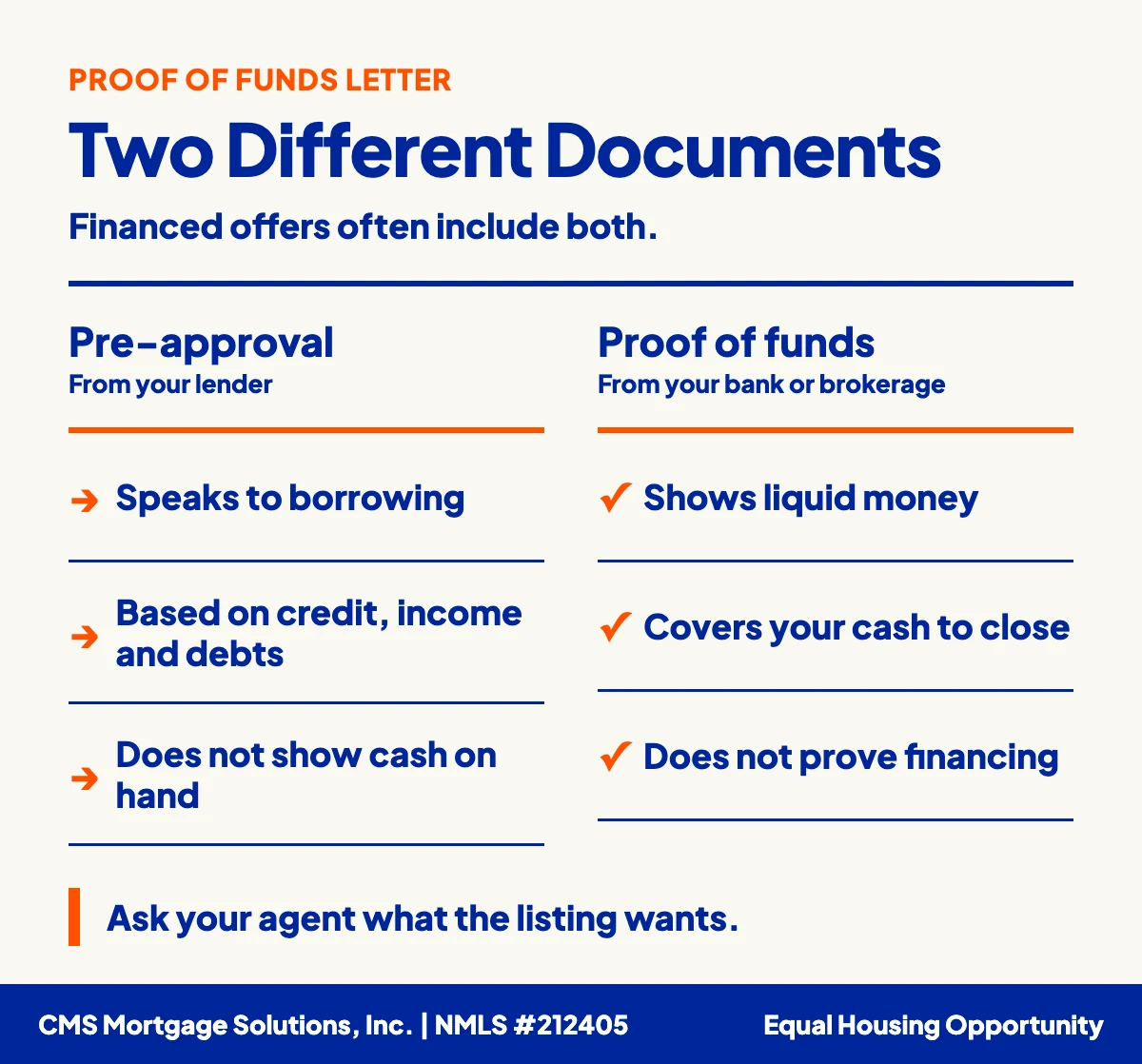
In real estate, "proof of funds" means evidence that the cash portion of your deal is real and available. It is not the same as a mortgage pre-approval letter. A pre-approval says a lender is willing to consider a loan based on your credit, income and debts. Proof of funds shows you have the cash you promised to bring.
Common forms of proof of funds include:
- A recent bank or credit union statement
- A letter from your bank on official letterhead confirming a balance
- An investment or brokerage statement showing liquid assets
- A combination of statements if the money sits in more than one account
Proof of funds for a seller is a matter of market practice. Practice varies by seller and listing agent. Some accept a redacted statement. Others want a bank letter. Ask your buyer's agent what the listing asks for before you send anything.
Cash offer vs financed offer
The amount you need to show depends on how you are buying.
Cash purchase. You typically need to show enough liquid funds for the full purchase price plus the closing costs you will pay. There is no lender backing the offer, so the seller's comfort rests on your documentation.
Financed purchase. In many offers, you attach two things:
- A mortgage pre-approval letter from your lender
- Proof of funds for your down payment, closing costs and earnest money
A pre-approval does not prove you have cash on hand. Proof of funds does not prove a lender will finance you. In a competitive market, a seller may want both.
See our guide to the mortgage pre-approval process.
What sellers usually look for
Seller expectations are market practice. They are not a CFPB or Fannie Mae form requirement, and they vary by seller and agent. A useful document commonly shows:
- The name of the bank or brokerage
- Your name as the account holder, matching the name on the offer
- A recent date
- An available balance large enough for your cash needs
- Enough of an account number for the institution to locate the account if asked, often the last four digits
- For a letter, official letterhead and a bank officer's name or signature
Protect your privacy. Many buyers redact full account numbers and unrelated transactions before sharing a statement with a seller. Your lender is different. It needs complete statements that show all transactions. Do not email account passwords or online banking credentials to anyone.
What your lender checks (this is different)
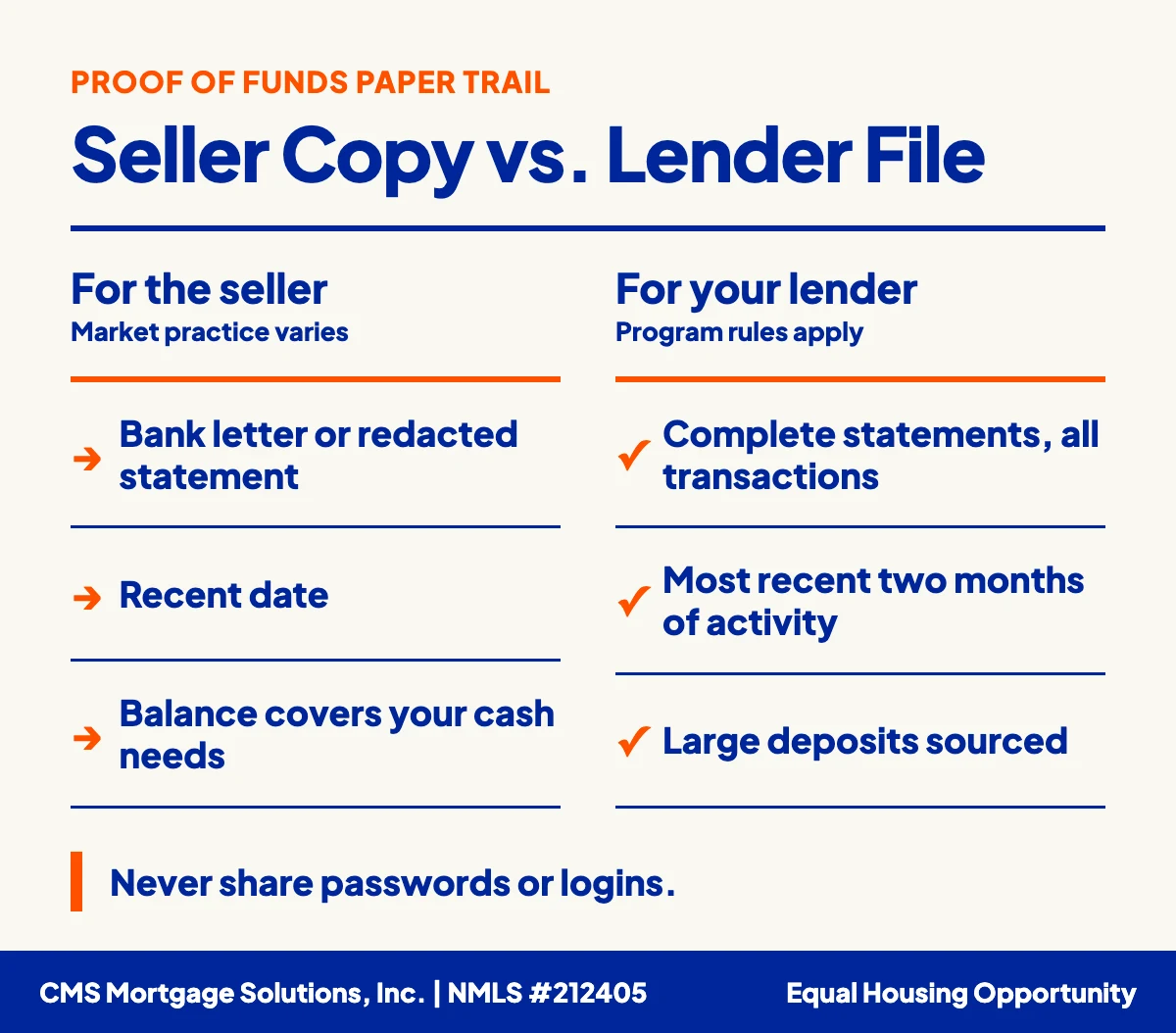
The letter you send a seller is for the offer. Your lender has its own rules for documenting assets used for the down payment, closing costs and reserves.
The Consumer Financial Protection Bureau (CFPB) lists your two most recent bank statements in the loan application packet, plus documentation of the source of your down payment, such as account statements showing at least two months of history of ownership. If some of the money was a gift, the CFPB says to get a signed statement from the giver stating that it was a gift. See our gift letter for a mortgage guide. The CFPB also notes that requirements vary by lender.
For conventional loans backed by Fannie Mae, the Selling Guide (B3-4.2-01) lets the lender verify funds with:
- A Request for Verification of Deposit (Form 1006), requested directly from the bank. The complete, signed and dated form must be sent directly from the bank, or
- Copies of bank or investment statements that clearly identify the institution, identify you as the account holder, show at least the last four digits of the account number, show the time period covered, include all deposit and withdrawal transactions and show the ending balance
For a purchase, statements must cover the most recent full two-month period of account activity (60 days, or the most recent quarter if the account reports quarterly). If your latest statement is dated more than 45 days before your loan application date, the lender should ask you for a more recent, bank-generated form that shows at least the last four digits of the account number, the balance and the date.
Statements may be computer-generated, including ones you download online. Online or faxed documents must clearly show the name of the bank and the source of the information, such as in the banner at the top of the page.
Large deposits get a closer look
If you moved money into the account you will use for the purchase, expect questions.
The CFPB says that if you have made one or more large deposits recently, be prepared to document the source. For Fannie Mae loans, a large deposit is a single deposit that exceeds 50% of your total monthly qualifying income for the loan (B3-4.2-02). On a purchase, if the money from a large deposit is needed for your down payment, closing costs or reserves, the lender must document that it came from an acceptable source. If part of a large deposit cannot be sourced, that amount is subtracted from your usable funds.
Examples of documentation include your written explanation or proof that you sold an asset. Fannie Mae also lists a copy of a wedding invitation to support gift funds. Your lender will tell you what it needs.
Fannie Mae says no further explanation is needed when the source is printed on the statement, such as a payroll direct deposit, a Social Security payment, an IRS or state tax refund, or a transfer between accounts the lender has already verified. A lender can still ask questions if it suspects the money was borrowed.
Plan the paper trail before you move money. One clean transfer from a documented account is easier than many unexplained deposits.
How to get a proof of funds letter
- Decide what you need to show. Cash price plus costs, or down payment plus closing costs and earnest money.
- Ask your bank or credit union. Request a proof of funds letter, or download recent statements from online banking.
- Match the name on the offer. The account holder should match the buyer name on the contract.
- Keep it current. Sellers and agents differ on how recent it should be. Ask your agent what the listing wants, and get a fresh copy if time passes before you submit.
- Ask your loan officer what the lender needs. Seller documents and lender documents are not always the same set.
If funds are coming from a brokerage or retirement account, ask early how long a sale or transfer will take. Retirement accounts can also carry tax and penalty rules that sit outside the mortgage file. Talk to a tax professional about those.
Common proof of funds mistakes
- Sending only a pre-approval when the seller asked for cash proof. These are different documents.
- Showing a balance that only covers earnest money. A seller may want to see the full cash you need to close, not just the deposit.
- Moving gift money in without a gift letter. Your lender will ask. Set the gift paperwork up first.
- Borrowing the cash. Fannie Mae says lenders must investigate any indications of borrowed funds. Talk to your loan officer before you borrow money you plan to show as your own.
- Sharing full account numbers or login details. Redact what you can for a seller. Never share passwords.
- Letting statements go stale. The CFPB says lenders like to see the most recent statements, so update them when your lender or a seller asks.
Proof of funds and the rest of your cash to close
Proof of funds is one piece of the money plan. You also need a clear view of down payment and closing costs. Our closing costs guide covers what to expect, and down payment options explained walks through ways to fund it. You may also qualify for down payment assistance programs in 2026. Buying for the first time? Start with our first-time homebuyer guide and check the hidden costs of buying a home.
FAQ
What is a proof of funds letter?
It is a bank letter or account statement that shows you have liquid money available for a home purchase. Sellers often ask for it with an offer.
Is a proof of funds letter the same as a pre-approval letter?
No. A pre-approval is from a lender and speaks to your borrowing capacity. Proof of funds shows cash you already have.
Do I need proof of funds if I am getting a mortgage?
Often yes. Sellers may want proof that your down payment and closing costs are ready, in addition to your pre-approval.
Can I use a bank statement instead of a letter?
Often yes. Many sellers accept a recent statement, but it varies. Your lender may prefer statements or a direct verification from the bank. Ask both parties what they need.
Can gift money count as proof of funds?
Gift money can be part of your cash to close when your loan program allows it, but you will need gift documentation for the lender. See our gift letter guide.
Will my lender accept the same letter I send the seller?
Not always. Lenders follow program rules for asset documentation. Fannie Mae, for example, has specific statement and Verification of Deposit requirements. Ask your loan officer what your file needs.
Sources
- CFPB, Create a loan application packet
- CFPB, Submit documents and answer requests from the lender
- Fannie Mae Selling Guide B3-4.2-01, Verification of Deposits and Assets
- Fannie Mae Selling Guide B3-4.2-02, Depository Accounts
Talk to a CMS loan officer
A clean proof of funds package helps your offer and your loan file. A CMS loan officer can tell you how much cash you need to document for your loan type and help you set up the paper trail before you write the offer. Talk to a loan officer or find a loan officer in your state.
---
This content is for educational purposes and does not constitute financial advice. Loan terms and availability vary by borrower. Pre-approval is subject to credit, income, asset, and property verification. It is not a commitment to lend.
CMS Mortgage Solutions, Inc. | NMLS #212405 | Virginia Beach, VA. Equal Housing Opportunity. NMLS Consumer Access. This is not a commitment to lend. Programs, rates, terms and conditions are subject to change without notice.